


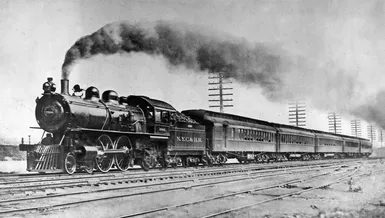
In 1893, the Empire State Express shattered speed records. Hauled by the famous 999 steam locomotive, the train connecting New York City to Buffalo hit 112 miles per hour. That made it the fastest land vehicle in the world. It was a moment of triumph for the New York Central Railroad Company. But that glory would not last.
The railroad itself had humble origins. It was founded in 1853. This was not a new line. It was a consolidation of ten smaller railroads. These tracks paralleled the Erie Canal between Albany and Buffalo. The oldest piece of that puzzle was the Mohawk and Hudson. It opened in 1831. It was New York state’s first railway.
The Men Who Built the Empire
The driving force behind this early consolidation was Erastus Corning. He was four times mayor of Albany. He also served as president of the Utica and Schenectady Railroad. That line was one of the roads that eventually joined the Central. Corning led the new company until 1864.
Then came Cornelius Vanderbilt. He was ruthless. He beat down the Central’s stock price. He won control in 1867. Vanderbilt merged the New York Central with his New York and Hudson railroads. Those tracks ran from Manhattan to Albany. He did not stop there.
In 1871, Vanderbilt added the Michigan Central Railway. Two years later, in 1873, he connected the system to the Lake Shore and Michigan Southern Railway. This extended his reach from Buffalo all the way to Chicago. The network grew aggressively. By the late 19th century, the system spanned 10,000 miles. It linked New York with Boston, Montreal, Chicago, and St. Louis.
Under his son William, the company acquired the New York, West Shore, and Buffalo Railroad in 1885. This added tracks on the west side of the Hudson River. The empire was built on speed and scale.
The Long Decline
The post-World War II era brought trouble. The railroad began to decline. Between 1946 and 1958, the company cut four of its six daily fast passenger runs between New York and Chicago. Rail travel was losing ground to cars and planes. The freight business was struggling too.
The industry responded with a massive, and ultimately fatal, merger. The New York Central’s chief competitor was the Pennsylvania Railroad. Both were ailing. In 1968, they merged to create the Penn Central Transportation Company. This new colossus had 21,000 miles of track.
The logic behind the merger seemed sound at the time. Executives hoped for a division of labor. Freight would be sent to New York and New England north along the New York Central’s water-level route. The Pennsylvania’s main tracks would serve the industrial needs of Philadelphia, Baltimore, and the Delaware and Schuylkill valleys.
It failed. The integration was a mess. The new road went into bankruptcy in June 1970.
The End of an Era
The collapse was swift. In 1971, the federal government stepped in. The National Railroad Passenger Corporation, known as Amtrak, took over passenger services. This marked the end of long-distance passenger trains on the former New York Central lines.
The remaining railroad assets did not disappear. They were merged with five other lines. This happened in April 1976. The new entity was the Consolidated Rail Corporation, or Conrail. However, the New York–Washington route was later transferred back to Amtrak.
The 999 locomotive is long gone. The Empire State Express no longer runs. But the tracks tell a story of rapid expansion and sudden collapse. The New York Central was once the backbone of American transport. Then it became a cautionary tale about overextension.
The landscape of American rail has changed. Amtrak still runs on many of those old routes. The freight corridors remain vital. But the era of the private, integrated railroad giant like the New York Central is over. The speed record of 112 miles per hour was broken decades ago. The decline of the company, however, remains a historical fact.


