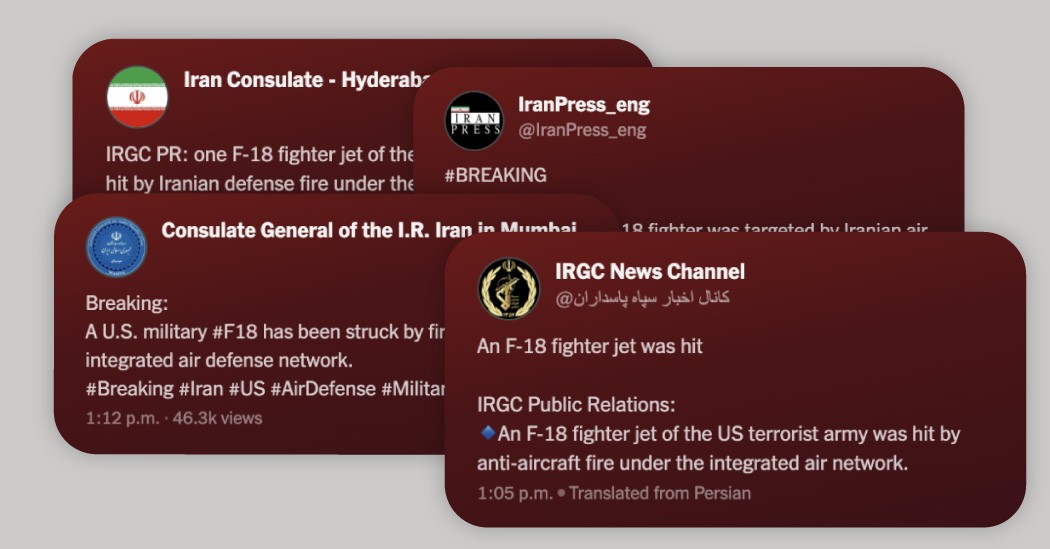
In late March, a grainy video surfaced online, purportedly showing an American F/A-18 fighter jet under attack. While the Pentagon quickly moved to deny the claim, the damage—or rather, the impact—was already done. The video garnered millions of views, serving as a masterclass in how modern information warfare operates.
By leveraging a sophisticated network of state media, coordinated social media accounts, and high-reach influencers, Iran successfully bypassed traditional gatekeepers to project an image of military dominance. This was not a random viral moment; it was a highly synchronized digital operation.
The Anatomy of a Viral Narrative
The spread of the “F/A-18 attack” claim followed a precise, rapid-fire timeline that allowed the narrative to outpace verification.
Phase 1: The Spark (1:04 p.m. – 1:14 p.m.)
The operation began with a coordinated “pincer movement” across different platforms:
– Initial Posting: An obscure, Iran-linked account on X posted the video in English, followed immediately by the Islamic Revolutionary Guards Corps (IRGC) on Telegram.
– Legitimization: Within minutes, official accounts of Iranian embassies and consulates reposted the claim. This gave the unverified video a veneer of diplomatic authority.
– Geopolitical Synchronization: Iranian state television shared the footage, which was almost instantly picked up by Russia’s RT. The near-simultaneous coverage suggests a high degree of coordination between Iranian and Russian media ecosystems.
– Early Amplification: By 1:14 p.m., pro-Russian influencer accounts like “Megatron” had already amassed nearly two million views, despite a total lack of corroboration from independent sources.
Phase 2: Manufacturing Consensus (1:21 p.m. – 1:32 p.m.)
To prevent skepticism from stalling the momentum, the narrative was refined and bolstered by artificial engagement:
– Addressing Discrepancies: The IRGC released an update claiming the jet fell into the Indian Ocean—a strategic detail likely intended to explain the absence of visible wreckage.
– Bot Activity: Digital forensics from firms like Cyabra revealed a mix of automated bot accounts and real profiles. These bots flooded posts with short, celebratory comments and emojis to create a false sense of overwhelming public support.
– The Influencer Effect: High-profile activists and influencers began sharing the content. Even when influencers added disclaimers (noting the claim was unconfirmed), their massive follower bases acted as a megaphone, pushing the narrative into mainstream feeds.
Phase 3: Global Saturation (1:33 p.m. – 2:05 p.m.)
By the two-hour mark, the claim had achieved “critical mass”:
– Cross-Platform Dominance: The video migrated from X and Telegram to TikTok, Facebook, and Instagram.
– Massive Reach: On X alone, mentions of the F/A-18 surged, ultimately generating over 35 million views.
– Media Echo Chambers: Major international outlets—ranging from Al Jazeera to state media in China and India—began reporting on the “attack,” often repeating the Iranian claims as fact.
The Counter-Response and the “Semantic Gap”
At 2:13 p.m.—just over an hour after the initial post—the U.S. Central Command issued a formal denial, stating that no American aircraft had been shot down.
However, the operation had already succeeded in creating a “semantic gap.” Because the initial claims were so pervasive, the denial sparked new debates rather than ending the rumor. Some users began questioning the specific wording of the Pentagon’s statement, debating whether a plane could be “hit” without being “shot down.” This nuance allowed the disinformation to persist in the public consciousness even after being debunked.
Conclusion: Iran’s information strategy succeeds by weaponizing speed and scale. By the time official denials are issued, the narrative has already been amplified by a global network of bots, state media, and influencers, making the truth difficult to reclaim in the digital flood.