


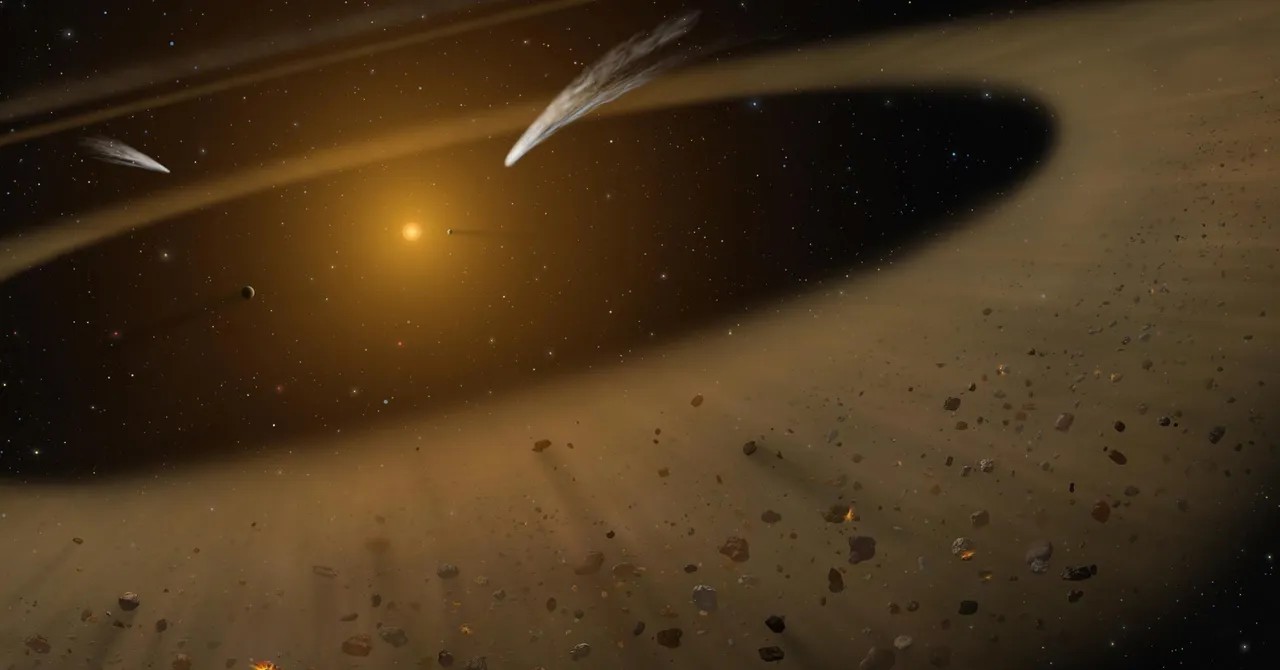
Beyond Neptune lies the Kuiper Belt, a vast region of icy remnants from the solar system’s formation, holding clues to its chaotic early history and potentially harboring undiscovered worlds. For decades, astronomers have charted this distant realm, but new observatories promise a dramatic surge in discoveries that could rewrite our understanding of the outer solar system.
A Deep-Frozen Time Capsule
The Kuiper Belt, extending from roughly 30 to 50 times Earth’s distance from the Sun (and possibly further), is a reservoir of primordial material. It contains dwarf planets like Pluto, icy comets, and fragments of early planetary building blocks. While approximately 4,000 Kuiper Belt Objects (KBOs) have been identified, the upcoming Vera C. Rubin Observatory’s Legacy Survey of Space Time (LSST) is projected to multiply that number tenfold. The James Webb Space Telescope will also contribute to this renewed exploration.
This surge in data isn’t just about counting objects; it’s about filling critical gaps in our knowledge. Current surveys are incomplete, leaving room for undetected KBOs, including potentially significant planetary bodies.
Unexplained Structures and Migrating Planets
The Kuiper Belt isn’t merely a scattered collection of debris. It contains peculiar structures, such as the “kernel” at 44 astronomical units (AU), a concentrated cluster of icy objects. This arrangement is thought to be a relic of Neptune’s turbulent migration through the early solar system.
The prevailing theory, dubbed the “jumping Neptune” scenario, suggests that Neptune’s outward journey through the proto-planetary disk swept up these objects, then abruptly halted its gravitational grip, leaving them clustered in the kernel. Further analysis has revealed a possible “inner kernel” at 43 AU, though confirmation is pending. These structures suggest the early solar system was far more dynamic than previously imagined.
The Hunt for Hidden Planets
The Kuiper Belt also fuels speculation about undiscovered planets. The hypothetical “Planet Nine,” first proposed in 2016, could explain the unusual clustering of KBO orbits. Researchers also theorize about a smaller planet, dubbed “Planet Y,” lurking closer to the belt at 80–200 AU.
The challenge lies in detecting these dim, distant objects. Even if no new planets are found, the search itself will refine our understanding of planet formation efficiency.
Beyond the Kuiper Cliff: The Outer Solar System’s Limits
The Kuiper Belt abruptly ends at around 50 AU, a boundary known as the “Kuiper cliff.” This sharp cutoff is anomalous; most debris disks around other stars extend much further. This suggests our solar system might be unusually compact.
Recent observations hint at a possible outer ring beyond the cliff at 100 AU, but confirmation requires further investigation. If confirmed, this would make our solar system more typical and less of an outlier.
A New Era of Discovery
The next few years promise a flood of data from Rubin and other observatories. Whether that data reveals hidden planets, confirms the outer ring, or simply refines our understanding of KBO distribution, it will reshape our view of the solar system’s origins. The Kuiper Belt remains a largely unexplored frontier, holding the potential for groundbreaking discoveries that could redefine our understanding of planetary formation and the deep past.
“What are we missing?” asks planetary scientist Renu Malhotra. The answer to that question may lie hidden within the icy depths of the Kuiper Belt, waiting to be revealed.


