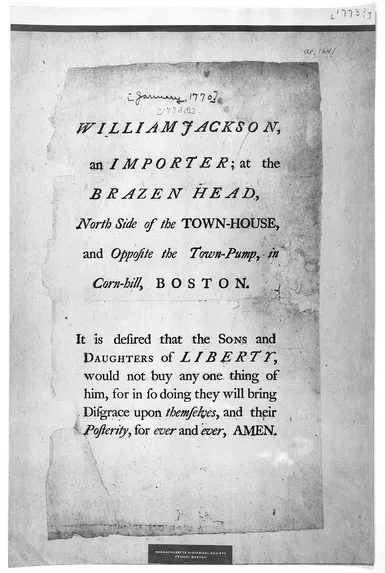
A January 1770 document warns the Sons and Daughters of Liberty to stop buying from William Jackson. He was a Boston merchant who ignored the colonial boycott of British imports. The Library of Congress holds this charge. It serves as a snapshot of the decade-long economic war.
The embargoes between 1765 and 1775 were more than just protests. These were calculated attempts to use economic pressure to force Britain to recognize political rights. Residents tried to use their wallets as weapons. It failed.
The first big push came with the Stamp Act of 1765. Colonists founded non-importation societies. Sons of Liberty and Whig merchants led the charge. They boycotted English products. The strategy seemed logical. British merchants and manufacturers faced trade restrictions. They suffered losses. They then pressured Parliament to repeal the laws. The boycotts worked, for a while. When the laws were repealed, the associations collapsed.
Then came the Townshend Acts of 1767. The pattern repeated itself. The boycotts continued. Pressure mounted. Repeal followed. The cycle lasted a decade.
For ten years, non-importation was the main weapon. The colonists used it in their failed attempt to enforce their demands on the motherland by peaceful means. But the landscape changed. The Intolerable Laws went into effect in 1774. The First Continental Congress responded immediately. They established both nonimport and nonexport committees. There was more at stake. The scope was broader.
But the lever was gone. Great Britain had opened new markets in Europe. European buyers picked up the slack. The expected effect on the parliament did not materialize. British merchants found alternative customers. The economic pain was diluted.
Colonists had relied on the assumption that Britain needed colonial trade. They were wrong. Or at least not wrong enough. The boycotts left the colonies economically isolated, while Britain’s economy remained intact. The result was no political concession. Positions tightened.
The failure of nonimportation shows a simple truth. Economic coercion requires asymmetric dependence. When both parties find other partners, the pressure eases. The colonists had the moral high ground. They lacked the economic stranglehold.
This difference between purpose and result was characteristic of the pre-revolutionary period. Boycotts were organized. They were disciplined. They were ultimately ineffective in the face of a globalized market. The revolution would not be won by boycotts. It would be won by something else. Something much more violent.