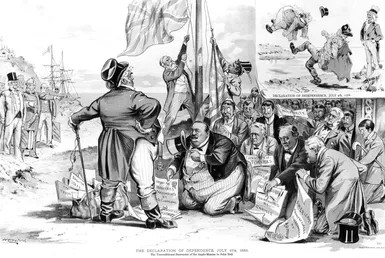
The Library of Congress has a famous cartoon called “The Declaration of Independence” that depicts pro-Tariff sentiment. It captures the tensions that continue to define modern trade debates. At the heart of this conflict is protectionism. This is the practice of shielding domestic industry from foreign competition. Governments use tools such as tariffs, subsidies and import quotas to create barriers to outsiders.
Almost all mainstream economists agree that free trade improves global economic performance. Despite that consensus, the countries continue to implement protectionist policies. The reason for this has nothing to do with the effectiveness of the textbook.
How Tariffs and Quotas Work
Government-levied tariffs are the most common protectionist measure. They work by raising the prices of imported goods. When imported goods become more expensive, they become less attractive to consumers. by comparison, domestic products seem to be more competitive.
Historically, protective tariffs have been used to stimulate struggling industries. Countries in recession or depression may resort to protectionism to protect local jobs. It also helps emerging industries in developing countries. These new sectors need time to grow before they can compete on the world stage.
“Protectionism may serve as a means to encourage the self-sufficiency of the defense industry.”
Import quotas offer a stricter alternative. Rather than simply raising prices, quotas set absolute limits on the quantity of goods that can be imported. This method tends to be more effective than tariffs. Tariffs don’t always dissuade consumers from paying higher prices for certain foreign products. When the limit is reached, the quotas remove the option.
A History of Rising and Falling Bars
History shows a clear pattern. Wars and economic depressions drive protectionism. Peace and prosperity encourage free trade.
In the 17th and 18th centuries, European monarchies favored protectionist policies. They wanted to expand trade and build their domestic economy. They did this at the expense of other countries. This approach became known as mercantilism. Today, these policies are largely discredited.
Great Britain began to shift away from protectionism in the first half of the 19th century. It had achieved industrial preeminence in Europe. By then, it didn’t need to hide behind walls. The repeal of the Corn Laws in 1846 symbolized Britain’s shift towards free trade. These laws placed duties on imported grain.
In the second half of the 19th century, protectionism remained relatively mild in Europe. France, Germany and other countries did impose tariffs. They wanted to protect their growing industrial sector from British competition. By 1913, however, customs duties were low throughout the Western world. Import quotas were hardly ever used.
After the First World War, That changed. In the 1920s, The damage and dislocation inspired Europe to constantly raise customs barriers. The great depression of the 1930s made it worse. Record unemployment led to epidemic of protectionist policies. As a result, World trade shrank drastically.
America’s trajectory
The United States has a long history as a protectionist country. Its tariffs peaked in the 1820s and again during the Great Depression. The Smoot-Hawley Tariff Act of 1930 is an important example. The average duty on imported goods will be increased by about 20%.
This approach changed in the mid-20th century. In 1947, the United States was one of 23 countries that signed the General Agreement on Tariffs and Trade (GATT). This is how a mutual trade agreement was made. The General Agreement on Tariffs and Trade (GATT) was revised in 1994 and replaced by the World Trade Organization (WTO) in Geneva in 1995.
Through the WTO negotiations, most of the world’s largest trading countries have lowered their tariffs significantly. The trading mechanisms are standardized. But the debate continues about who should be protected and who should be free to compete. The data shows the benefits of public markets. Politics often tells a different story.
Why does protectionism still exist in modern trade agreements?
This April 1929 photo by Willis C. Hawley and Reed Smoot captures a specific moment in history that changed the way the world viewed tariffs. Shortly after this photo was taken, the U.S. House of Representatives passed the Smoot-Hawley Tariff Act. This remains a warning of how high tariffs can cause a global recession. But if we look at the trade today, a different pattern is emerging.
Mutual trade agreements rarely aim to eliminate protectionism entirely. Instead, they tend to limit it. Instead of calling for a zero tariff, they set limits on how high tariffs can go. This approach recognizes the stark reality that industries in many countries continue to suffer economic hardship and job losses, which they blame on foreign competition.
When a local factory closes, political instincts often lead to wanting to build a wall. Industry groups say cheap imports are killing jobs. Politicians listen because they have votes. But removing protectionism completely ignores the pain of workers who feel left behind by globalization.
So where does this leave us? The agreement we finally reached limits but does not eliminate protectionist measures. This is a compromise. It allows some level of trade protection while avoiding the tariff wars that deepened the Great Depression.
“Reciprocal trade agreements typically limit protectionist measures and do not eliminate them entirely.”
This middle ground is not perfect. Critics argue that even limited protectionism can distort markets. They point out that consumer prices are often raised to support inefficient domestic industry. Proponents argue that without these guarantees, certain key industries would disappear entirely, creating dependence on foreign suppliers and creating national security risks.
In fact, the question is not whether we should put up barriers to trade. The debate is about how much History teaches us that if the barriers are too high, everyone loses. But even if they are controlled through negotiations, trade can still function.
We still see calls for protectionism whenever the industry takes a hit. It happens with steel. It happens in agriculture. It happens in technology. The mechanism changes, but the impulse remains the same.
Can we find a way to protect workers without isolating ourselves from the global economy? The answer seems to lie within these constraints. It’s not completely free trade, and it’s not closed borders. Somewhere in between, the rules are clear and the penalties for breaking them are real.